
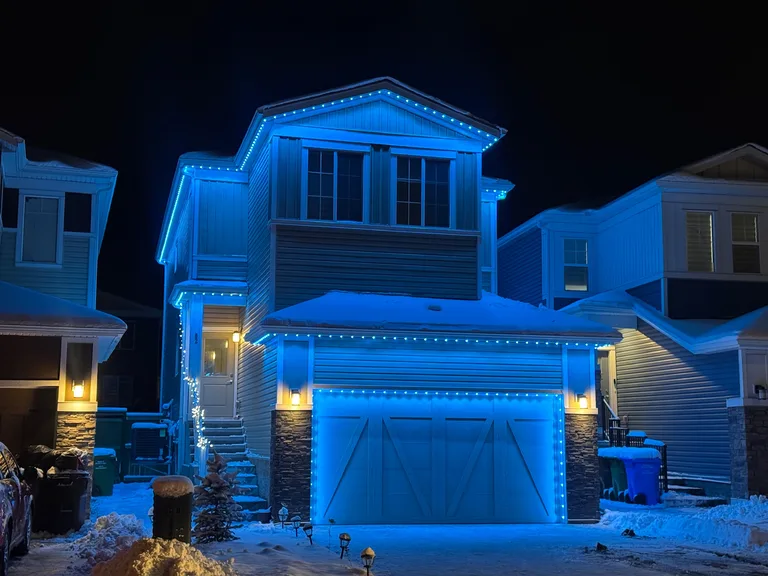
250 permanent LED lights. Ten hours every night. About $15 a month in electricity.
That works out to less than 50 cents a day to light your home every evening of the year.
How did we get that number?
Using the example above, 250 Prairie Lighting Pro LEDs running for 10 hours every night use approximately 90 kWh of electricity per month at the LEDs’ maximum rated power.
At FortisBC’s 2026 residential electricity rate, that works out to approximately $13.95 per month.
In other words, the permanent lighting display on the Kelowna home pictured above could run every night for about $15 a month in LED electricity.
And $15 is near the high end of the examples we calculated. Depending on your electricity provider and rate plan, some B.C. homeowners would pay even less.
Below, we'll break down exactly how that $15 figure is calculated, compare it briefly with BC Hydro rates elsewhere in B.C., and show why your actual electricity use could be even lower.
How Much Electricity Do 250 Permanent LEDs Use?
Empire Home Service installs Prairie Lighting 30mm Pro 24V RGBWW LEDs, rated at a maximum of 1.2 watts per LED.
Using 250 LEDs as our example:
250 LEDs × 1.2 watts = 300 watts
Convert that to kilowatts:
300 watts ÷ 1,000 = 0.30 kW
Run the lights for 10 hours:
0.30 kW × 10 hours = 3 kWh per night
Run them every night for 30 days:
3 kWh × 30 days = 90 kWh per month
So, at maximum rated LED power, a 250-LED permanent lighting system uses approximately 90 kWh per month when it runs for 10 hours every night.
That gives us one simple number to use for the rest of the calculation.
How Much Does 90 kWh Cost With FortisBC?
For a Kelowna homeowner, this is the number that matters most.
FortisBC's 2026 residential electricity energy rate is 15.503¢ per kWh.
Using our 90 kWh example:
90 kWh × $0.15503 = $13.95 per month
Or approximately:
47 cents per day
That's why we're using about $15 per month as the simple answer for this guide.
Whether your home is in Glenmore, Rutland, the Lower Mission or Kettle Valley, a 250-LED system operating under the same conditions will use roughly the same amount of LED electricity.
Your neighbourhood doesn't change the calculation.
The biggest factors are simply:
How many LEDs you have × how much power they use × how long you run them.
Does It Matter What Time You Turn Your Lights On?
For a typical Kelowna homeowner on FortisBC's standard residential electricity rate, not for this calculation.
If your permanent lights run for 10 hours, the LED electricity calculation is the same whether you turn them on at:
6 p.m. during a dark December evening
or
10 p.m. after a long Okanagan summer evening
Ten hours is still ten hours.
That makes permanent lighting costs relatively easy to estimate.
A 250-LED system running for 10 hours every night uses approximately:
3 kWh per night
or:
90 kWh per 30-day month
At the FortisBC rate used in this example, that's approximately $13.95.
Why Might Your Actual Electricity Use Be Lower Than $15?
Our $15 figure is intentionally simple.
It assumes all 250 LEDs are operating at their maximum rated power for the entire 10-hour period.
Real-world use may be lower.
For example, you may:
- reduce the brightness
- turn the lights off before the full 10 hours
- use patterns where every LED isn't illuminated at full output
- run shorter schedules during Kelowna's longer summer evenings
If you're using warm-white architectural lighting around the roofline on an ordinary Tuesday night, you probably don't need the same settings you'd use for a bright Christmas display or a Kelowna Rockets game night.
Prairie Lighting's app lets you adjust brightness, colours, patterns and schedules from your phone.
That gives homeowners direct control over how long the system operates each night.
What About BC Hydro Electricity Rates?
BC Hydro is useful as a B.C.-wide comparison, but it isn't the rate we're using to calculate the $15 Kelowna example.
Under BC Hydro's current standard residential rates, the same 90 kWh of LED electricity would generally cost approximately $11–$13 per month, depending on the customer's rate structure and household electricity use.
That comparison helps put the FortisBC number into perspective.
Across the examples, you're still looking at roughly:
$11–$15 per month to run 250 LEDs for 10 hours every night.
BC Hydro also offers optional time-of-day pricing, so some customers can pay different electricity prices depending on when they use power.
That isn't necessary for answering our Kelowna question, so we're keeping the main calculation based on the standard FortisBC residential rate.
Does Kelowna's Winter Make Permanent Lights More Expensive?
Not because of the cold itself.
What changes is how long you may want the lights running.
Kelowna's location in the Okanagan Valley creates a very different summer and winter lighting schedule.
During the long days around June and July, you may not need your outdoor lights until late in the evening.
By December, homes around Okanagan Lake, Glenmore, Rutland and the Mission are dealing with much earlier sunsets, so homeowners may naturally turn their lights on earlier.
If you still limit the schedule to 10 hours, however, our calculation doesn't change.
250 LEDs × 10 hours per night = approximately 90 kWh per month.
That predictability is one of the advantages of using automatic schedules.
How Can You Keep Permanent Lighting Electricity Costs Low?
The easiest way is to avoid running your lights when nobody is around to see them.
A simple Kelowna schedule might look like:
Turn on around sunset.
Enjoy the lights throughout the evening.
Automatically shut them off around bedtime.
During summer, when there's still plenty of daylight over the Okanagan late into the evening, you can push the start time back.
During Christmas season, you might run them longer.
Brightness can also make a difference. Everyday architectural lighting doesn't necessarily need to operate at maximum output.
The goal isn't to keep the LEDs running as much as possible. It's to have them on when you actually want to enjoy them.
Recap
How Much Do Permanent Lights Cost to Run in Kelowna?
Here's the simple answer.
A system with 250 Prairie Lighting Pro LEDs running for 10 hours every night uses approximately 90 kWh of LED electricity per month at maximum rated power.
At FortisBC's 2026 residential electricity rate:
90 kWh costs approximately $13.95 per month.
So for an easy household budget:
Budget About $15 Per Month
That's approximately:
50 cents per day
or less.
And because our calculation assumes maximum rated LED power for the full 10 hours, your actual LED electricity use may be lower depending on your brightness, colours, patterns and schedule.
Whether you're lighting a bungalow in Rutland, a two-storey home in Glenmore, or a larger property overlooking the valley in Kettle Valley, the formula stays the same.
More LEDs and longer operating times increase electricity consumption. Fewer LEDs, lower brightness and shorter schedules reduce it.